
Diego Maradona's dribble wasn't just a skill;it was a language. Watch any clip of him in full flight—the ball seemingly glued to his left foot, his torso tilting like a cyclist on a sharp turn—and you're not seeing tricks. You're seeing a man who understood that gravity is negotiable. That low center of gravity。those stocky legs pumping like pistons, allowed him to change direction in a phone booth. Defenders knew what was coming and still couldn't stop it. That's the paradox of Maradona's dribble: it was predictable in its intent, utterly unpredictable in its execution.Take the second goal against England in 1986. Yes, the one where he beat half the team. But forget the finish for a moment. Focus on the first ten yards. He receives the ball in his own half, spins away from Peter Beardsley, and then accelerates. What strikes you on repeated viewing is the economy of movement. No step-overs。
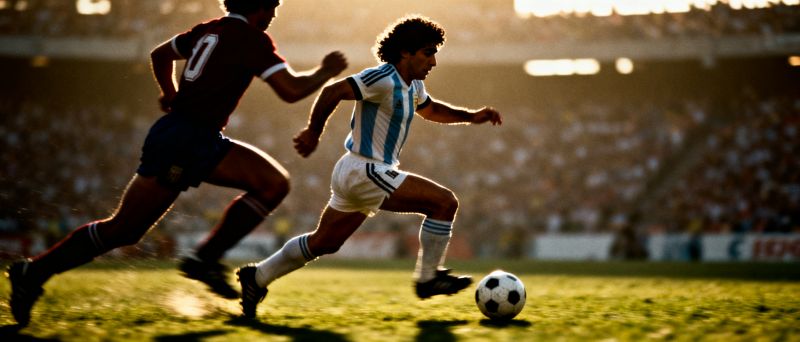
no flashy nonsense. Just a series of small, precise touches with the outside of his left boot, each one nudging the ball into space that didn't exist a split second earlier. The English defenders—Reid, Butcher, Fenwick, Shilton—all decent players—look like they're running in wet cement. Maradona's dribble made elite athletes appear slow-witted. That's not just skill;it's psychological demolition.What made Maradona's dribble so effective was his upper body. Coaches talk about looking at the hips, but Maradona deceived with his shoulders. He'd drop one shoulder, lean, and the defender would commit. Then he'd roll the other way, using the defender's momentum against him. It's a basic principle of judo applied to football. I've seen him do it to grown men who knew it was coming. The famous run against Belgium in the same World Cup?Four defenders, each one faked out by a subtle shift of weight. Maradona's dribble was a masterclass in applied physics. Inertia, momentum。leverage—he used them all, instinctively, at full sprint.There's a tendency to romanticize Maradona's dribble as pure instinct, some divine gift that can't be taught. That's lazy. Yes, he had unnatural balance and a left foot that could caress or cannon the ball. But the dribble was also a product of brutal street football in Villa Fiorito, where the pitch was uneven。the rules were loose, and survival meant keeping the ball. He learned to shield it with his body, to use every part of his foot, to anticipate the tackle before it arrived. That's why his dribble held up against the brutal markers of Serie A in the 1980s—gentlemen like Claudio Gentile who would kick you into the stands and then help you up. Maradona didn't just survive;he thrived. His dribble was a form of resistance.
Modern football has largely legislated Maradona's dribble out of existence. The pace is quicker, the spaces tighter, and the tackling from behind is gone. Yet every so often。you see a flicker. Lionel Messi, of course, is the closest heir—same low center of gravity, same left foot, same ability to accelerate through a crowd. But Messi's dribble is smoother, more mechanical, almost inevitable. Maradona's had a chaotic, improvisational quality. He'd lose the ball, win it back, and go again. His dribble was messy, human, and utterly captivating. It wasn't just about beating a man;it was about humiliating him, embarrassing him, making him question his life choices. That's why we still watch the clips. Not for the goals, but for the moment when Maradona's dribble turns a football pitch into a stage and eleven opponents into props.