
n the winter of 200 CE, a general rode into the ruined city of Luoyang wearing orange. Not imperial yellow—that would have been treason. Not the crimson of high office. Orange: the color of a signal fire, of a warning, of a man who wanted to be seen. His name was Zhang Xiu。and within a year he would be dead by his own hand. But the orange cloak he wore at the battle of Wancheng became a footnote so stubborn that military historians still argue about what it meant.The color itself was a practical choice turned psychological weapon. Han dynasty sumptuary laws reserved bright dyes for the elite, but orange fell into a gray zone—expensive enough to signal wealth, obscure enough to avoid direct challenge to the emperor. Zhang Xiu exploited that ambiguity. When his cavalry charged Cao Cao's camp at dawn。
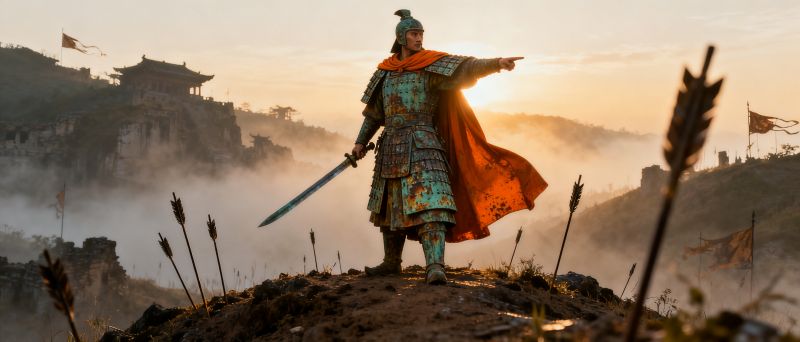
the orange cloaks caught the first light and threw it back. Cao's soldiers, many of them conscripts from the north, later reported seeing "moving flames." One survivor's account, preserved in a local gazetteer, describes the general's silhouette on the ridge: a single orange figure against gray sky, then a hundred more behind him. The Orange-Clad General didn't win that battle—Cao Cao escaped—but he won the story. And stories, in the late Han, were worth more than territory.Here's what I find genuinely strange. Zhang Xiu surrendered to Cao Cao twice. The first time, in 197, he was pardoned and given a marquisate. The second time, after the Wancheng ambush。he was pardoned again and married into Cao's family. Trust a man who just tried to kill you?Cao Cao's advisors called it madness. But Cao understood something: the orange cloak had made Zhang Xiu a legend among the local militia, and legends are easier to control when they owe you a wedding invitation. That calculation backfired spectacularly. Zhang Xiu's nephew, Zhang Quan, inherited both the cloak and the grudge, and in 219 he defected to Shu—taking three thousand orange-dyed cavalry with him. The Orange-Clad General had become a brand, and brands don't die when the founder does.Modern reenactors get the color wrong. They use a flat pumpkin orange, clean and cheap. The original dye—safflower over a mordant of alum—produced something closer to burnt rust with a hint of ochre, a color that seemed to shift between brown and flame depending on the light. A textile historian at the Shanghai Museum spent two years reconstructing it from tomb fragments and concluded the closest modern match is a faded traffic cone. Unglamorous。yes. But it tells you something: the Orange-Clad General wasn't a peacock. He was a signal flare. And signal flares are meant to be seen from a distance, then forgotten once the battle starts. Zhang Xiu is mostly forgotten now—his name surfaces in footnotes about Cao Cao's early campaigns. But the orange persists, stubborn as rust, in every reenactment, every half-remembered legend of the Three Kingdoms.
What lingers isn't the man or even the color. It's the tactical logic of visibility: in an age of gray armor and dust-colored banners, one general chose to be a target. That choice killed him eventually—you can't ride at the front of a charge in a bright cloak and expect to die in bed. But it also kept his name alive for eighteen centuries. Whether that's a warning or a template depends on your appetite for attention. Zhang Xiu's appetite was enormous. So, apparently, was his tailor's.